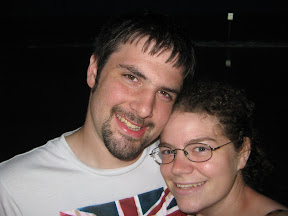
 Welcome to my Blog "Erbgħa Xhur fil-Malta", the title of which means "Four Months in Malta" in Maltese. That being the title of course that is the subject of this blog. My name is Andy Knight if you're stumbling on this blog from outside my circle of acquaintance and I am an Anthropology undergrad major at George Mason University and I am currently studying abroad at the University of Malta from October 2008 to February 2009. I also happen to be engaged to be married to the wonderful love of my life Corey in the picture with me here :)
Now for a little bit about this strange place in which I am now studying. Malta is an island just south of Sicily in the Mediterranean Sea. Its name most likely comes from the Greek word μέλι (meli) since they called it Μελίτη (Melité). Meli means honey, so the theories point to honey production or other related reasons being why the Greeks called it that name. The other equally plausible way is the Phoenician word "Maleth" (haven). I say equally plausible because Greek traders had influence on Malta from several hundred years BC, but the Phoenicians are the first people to have colonized the island (not its first peoples), and thus had even more substantial influence. Linguistically speaking it's a much more plausible and simple change to go from Melite to Malta than Maleth to Malta, elision of vowels is very easy to do especially in an Semitic language with their tendency towards consonant clusters. Though by the same token Semitic languages usually prefer vowels at the end of words so it's hard to say.
As I said before the Phoenicians were the first to colonize but actually Malta has been inhabited by man since at least 3600 BC! There are many prehistoric ruins on Malta, many of them some of the oldest man made structures in existence. The prehistoric Maltese people built megalithic structures much like Stonehenge or the Pyramids, but nearly all of the ruins, especially Ġgantija in Gozo and Ħaġar Qim were built a full millenia before the pyramids! Around 1000 BC the Phoenicians arrive and colonize the island, they hold sway first as Phoenicians and then as Carthaginians, although there is evidence of some Greek colonization as well. After the Punic Wars of the 200s BC Malta comes under Roman control. During this period is when St. Paul (Paul of Tarsus) shipwrecks on Malta in AD 60, this is recorded in the Acts of the Apostles 28:1-10 (NIV). After the fall of Rome, it fell under the control of the Byzantine empire, and then more significantly was taken over by the Arabs in 870 AD. The Arabs left an indelible mark on Maltese society as Maltese is an Arabic based language, along with many other things such as the city of Mdina and numerous place names, structures, agricultural technologies and industries.
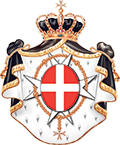 Eventually the Normans take control for a brief period before Malta spends the late middle ages changing hands between various kingdoms, Aragon, Sicily, the Angevins and Rome. Crucially in 1522 Suleiman II kicks the Knights of St. John of Jerusalem (Hospitallers) out of the island of Rhodes. Malta is then given over to the order, who establish the current capital of Valletta, many fortifications and many castles and palaces. (The picture at left is the emblem and seal of the current incarnation of the Sovereign Military Hospitaller Order of St. John of Jerusalem of Rhodes and of Malta) Malta repelled an Ottoman siege in 1565 as well known as the first Great Siege of Malta. The Hospitallers were eventually all but destroyed by Napoleon and he even landed on Malta for a brief period. Eventually the Napoleonic French gained the ire of this now fiercely devout Roman Catholic Nation when some of their beloved churches were pillaged at which point they rose up and sought the aid of the British Empire, becoming a crown colony in 1814 under the Treaty of Paris. Tensions build in the early part of the 20th century for independence but are interrupted by the entry of Britain into World War II and even more crucially, the entry of Italy on the side of the Axis. Malta becomes a crucial naval port and is held despite 6,700 tons of bombs dropped on the island in what was called the Second Great Siege.
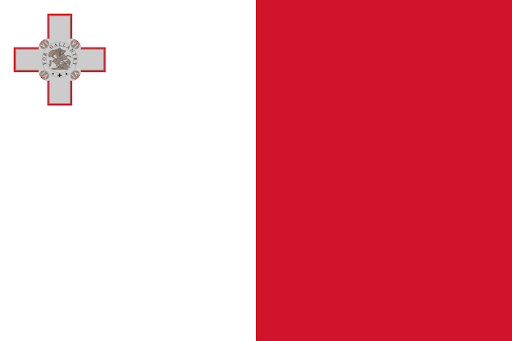 In 1942 King George VI awards the George Cross to the whole island for their bravery. After World War II independence sentiments reappear and eventually the island is granted independence but retains Queen Elizabeth II as the head of state in 1964. Ten years later Malta begins the Republic of Malta but stays within the Commomwealth. In 2004 Malta joined the European Union and finally most recently on the first of this year, Malta adopted the Euro as its currency. The flag on the right is the flag of the Repubblika ta' Malta, which was adapted from the Hospitaller flag, in the top left corner is a small emblem of the George Cross.
So that's great and all Andy/holy crap that was boring as heck, but where exactly are you on this island?
I live in the village of Ħal Lija or Lija for short, that's pronounced lee-yuh as the j is a y sound in Maltese. It's one of the residential centers of the country, being close to the largest city in Malta Birkirkara (B'Kara). It's also home to the Belvedere tower or the Lija Tower and the Lija Parish church as far as "sights" go. I am also very close to the San Anton palace and gardens. The map below shows were I am on Google maps:
View Larger Map
So now for a quick how to on this site. The top row is the navigation bar, "initial" takes you to this post, blog takes you to the front page with the latest entry, photos takes you to my picasa site where all my latest photos are located, profile takes you to my profile on facebook (only for my networks and friends, if I don't know you don't bother friending me please), maps takes you to maps of my time here, locations, buses various maps of various things, especially walks that I have done around the island.
A Note on the Language
Maltese is a Semitic language like Arabic and Hebrew, but, like English, has had copious amounts of influence since it was first spoken as Arabic, Particularly the presence of a nobility which spoke different languages. This means that its vocabulary is heavily influenced by languages like Italian and English (and Latin, Greek, Phoenician, French, etc.). It is also written in a latin based script, it is the only Arabic based language to be written in latin script, it just has a few odd letter Ħ and Ġ for instance which are a heavy h sound (like in Arabic) and Ġ which is similar to the J sound in English. I do not know Maltese yet I will be taking a class in it, but thankfully do to its long history as part of the British empire, most if not all of the population speaks English as well, in fact Malta is often a destination for people from other parts of the world to help learn English, English teaching is actually something of an industry here. I will be frequently using Maltese here as it fascinates me, and hopefully as you read you will learn some too!
Saħħa (bye) for now my friends!

0 comments:
Post a Comment